You have spent weeks learning digital marketing, and understand SEO. You have set up Google Analytics. Maybe you have even published a few articles on your practice site.Getting your first digital marketing client is the biggest challenge every beginner faces after learning the basics. Many people understand SEO, social media, or ads, but they struggle with one question: how to get your first digital marketing client without experience.
In reality, landing your first client is not about having advanced skills or certifications. It is about building proof, choosing the right service, and knowing how to approach real businesses with confidence.
This guide will show you a step-by-step system on how to get your first digital marketing client, even if you have zero experience. You will also learn how to create a portfolio, write a strong outreach message, and turn your first project into long-term paid work.
New to digital marketing entirely? Start with How to Start Digital Marketing from Zero first, then return here once your foundation is built.
Why “Just Apply for Jobs” Doesn’t Work at the Start
Most beginners open a job board, submit ten applications, and hear nothing back. Consequently, they assume they need more certifications, so they take three more courses and submit ten more applications. The cycle repeats.
The real problem, however, is not qualifications. It is proof.
Employers and clients are not looking for someone who has watched digital marketing tutorials. They are looking for someone who has produced a result. Therefore, the most effective path to getting your first digital marketing client is not applying; it is doing the work first and letting the results speak.
In other words: manufacture the proof before you pitch.
Step 1: Choose Your Entry Specialization
Before you reach out to anyone, you need to know exactly what you are offering. Because “digital marketing” is not a service, it is a category. Clients and employers hire for specific skills.
Therefore, pick one of the following based on your strengths:
SEO is ideal if you write well and think long-term. Moreover, it is one of the most in-demand services among small businesses and local service providers who want Google traffic without paying for ads indefinitely.
Email marketing setup is ideal if you are organized and detail-oriented. As a result, it is a particularly accessible entry point, because most small businesses have no email list at all, or a broken one, making even basic setup an immediate and visible win.
Paid ads management is ideal if you are analytical and comfortable with numbers. However, because mistakes cost real money, start with very small budgets on your first project and be transparent about your experience level.
Social media content is ideal if you create content naturally and consistently. In addition, it is the easiest specialization to demonstrate in your own portfolio before you have any clients.
Google Analytics setup and reporting is an underrated and undersupplied service. Most small businesses have GA4 installed, but no idea how to read it. Consequently, offering to set it up properly and deliver a simple monthly report is an immediately valuable service with almost no competition at the beginner level.
Pick one. Position everything around it. Then move to Step 2.
Step 2: Build Portfolio Proof Before You Pitch Anyone
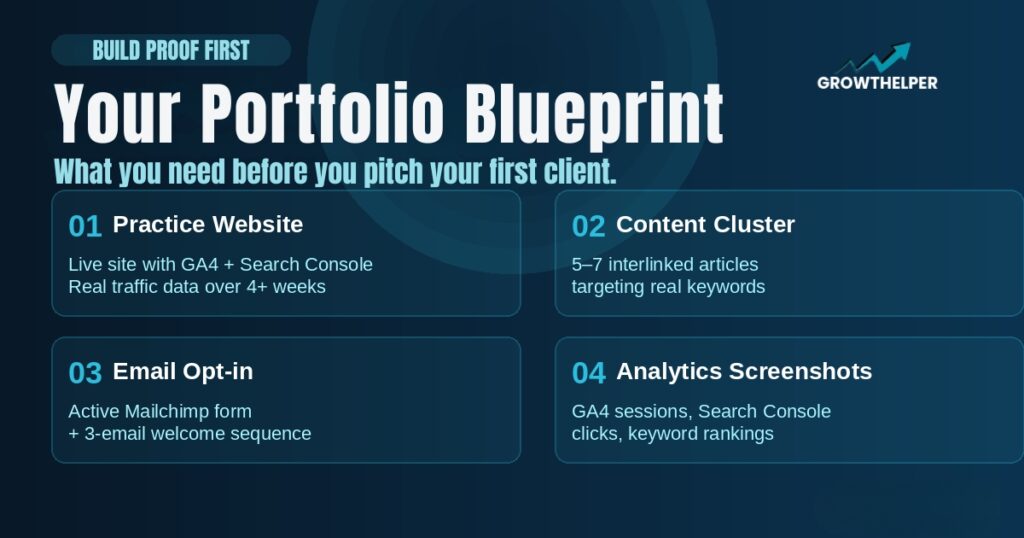
Here is the move that separates beginners who get clients from those who do not: build real proof on your own site before asking anyone to trust you with theirs.
This means having, at minimum:
- A real website with SEO implemented and GA4 tracking data, not a blank dashboard, but actual sessions, keywords, and trends over time
- At least 5–7 published articles targeting real keywords, with Google Search Console showing impressions and clicks
- A working email opt-in with at least one automated welcome sequence running in Mailchimp
- Screenshots showing real progress , even small progress , documented over weeks
You do not need thousands of visitors to make this convincing. You need evidence that you understand the process, have set things up correctly, and can make decisions based on data.
For example, a Google Search Console screenshot showing 340 organic sessions and a first-page ranking for a long-tail keyword after eight weeks of work is more persuasive than any certificate, because it proves you can execute, not just study.
Free tools to build your proof portfolio:
| Tool | Purpose | Cost |
| WordPress.com or Wix | Your practice website | Free tier |
| Google Analytics 4 | Traffic and behavior data | Free |
| Google Search Console | Search impressions and keyword tracking | Free |
| Google Keyword Planner | Keyword research | Free |
| Mailchimp | Email opt-in and automation | Free up to 500 contacts |
| Canva | Visual content and graphics | Free tier |
Step 3: Write a Case Study That Does the Selling for You
A case study is the single most powerful document in your digital marketing portfolio. Not a certificate. Not a skill list on a CV. A documented story structured around three things:
- The situation: what problem existed before you started
- The approach: what specific steps you took and which tools you used
- The results: what changed, with data and screenshots
Moreover, your first case study does not need to come from a client. It can , and should , come from your own practice site. Here is an example of what a convincing entry-level case study looks like:
“I launched a practice website targeting the keyword ‘home workout routines for beginners’ with zero backlinks and no domain authority. Over eight weeks, I published six interlinked articles, optimized every title tag and meta description, and submitted the XML sitemap to Google Search Console.
By Week 8, the site was receiving 340 organic sessions per month. The primary article ranked on page two for the main target keyword and on page one for three related long-tail variations. The email opt-in form was converting at 3.2% of visitors.”
That paragraph , paired with real screenshots , gets you a meeting. A list of courses and a Google certificate, however, does not.
Use this structure for your case study:
- 150-word situation overview: What was the starting point?
- Bullet list of actions: Specific tools used, steps taken, timeline followed
- Data table or screenshot: Before vs. after, GA4, Search Console, or email metrics
- One honest reflection: What worked best and what you would do differently
Therefore, once your practice site has 4–6 weeks of data, write this document. Publish it on your website and on LinkedIn as a long-form post.
Step 4: Land Your First Real Project (The Right Way to Offer Free Work)
Here is the highest-leverage action a digital marketing beginner can take: offer a free, scoped project to a real local business in exchange for a testimonial and permission to document your results.
This is not working for free indefinitely. It is a deliberate, short-term trade, your time and skill in exchange for the proof and access that makes paid work possible. Because one documented result from a real client is worth more than ten certifications.
How to Find the Right Business to Approach
Look for small local businesses with:
- A website that does not appear in Google search for its own core services, for example, a plumber in your city whose site does not rank for “plumber [city name]”
- No Google Business Profile, or one that is unclaimed or incomplete
- No visible email newsletter, opt-in form, or social media presence
- Active customers but weak online presence, independent restaurants, trade businesses, local retailers, or solo professionals
These businesses have real marketing problems. Moreover, they have nothing to lose by letting you help, and everything to gain.
The Outreach Message That Gets Responses
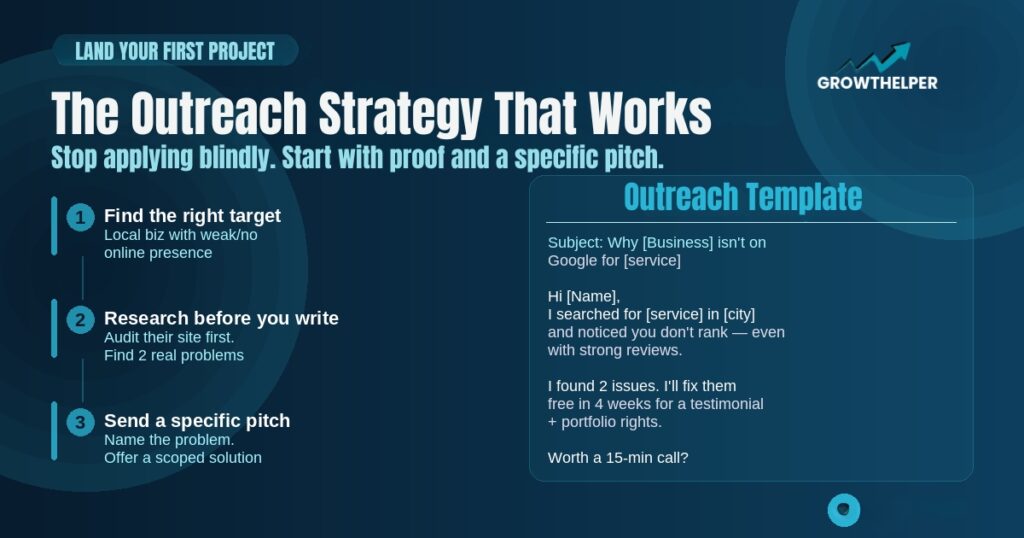
Do not send a generic “I’m learning digital marketing and would love to help” message. Instead, be specific. Show them you have already looked at their situation before you reached out.
Here is a template that works:
Subject: I found why [Business Name] isn’t showing up on Google for [service]
Hi [Name],
I was searching for [specific service] in [city] last week and noticed that [Business Name] doesn’t appear on the first page, even though you have genuinely strong reviews compared to the businesses that do rank.
I ran a quick audit of your website and found two specific issues that are likely holding you back: [Issue 1, for example, missing title tags on your main service pages] and [Issue 2, for example, no Google Business Profile optimized for local search].
I have been studying SEO, and I am building my portfolio. I would like to fix these issues for you over the next four weeks, at no cost, in exchange for a written testimonial if you are happy with the results, and permission to use the before-and-after data in my portfolio.
Would a 15-minute call this week work?
Send this to 5–10 businesses. Because you are being specific and showing genuine research, one or two will say yes. That is all you need to get started.
What to Do on the Project
Scope it tightly. Do not promise a complete website redesign. Instead, offer one specific, deliverable thing:
- Fix all title tags and meta descriptions across the site
- Set up and fully optimize their Google Business Profile
- Write two SEO-optimized blog posts targeting local keywords
- Set up GA4 and deliver a simple monthly traffic report they can actually understand
- Build a basic email opt-in and a 3-email welcome sequence in Mailchimp
Complete it thoroughly. Document every step with before-and-after screenshots. Deliver it with a clear one-page summary of what you did and what changed. Then write your case study immediately while the details are fresh.
Step 5: Get Certified, in the Right Order
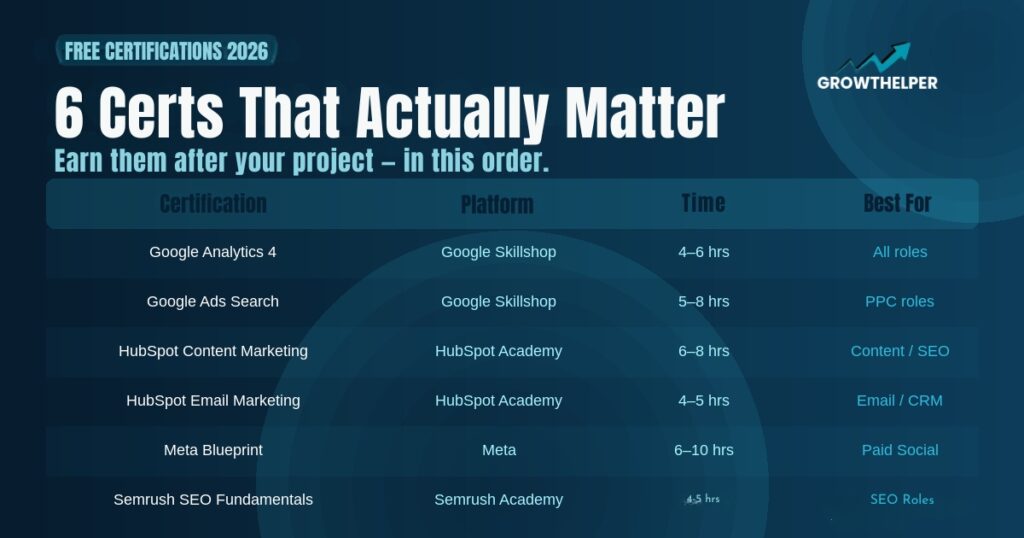
Certifications are not the most important element of your portfolio. However, they are a recognized credibility signal, and the most valuable ones are entirely free in 2026.
The key, therefore, is to get certified after you have done the real project work. Because when you earn a certificate after applying a skill, you understand it at a deeper level , and you can speak to it convincingly in an interview or client conversation.
| Certification | Platform | Time needed | Get it when |
| Google Analytics 4 | Google Skillshop | 4–6 hours | After your Week 2 analytics setup |
| HubSpot Content Marketing | HubSpot Academy | 6–8 hours | After publishing your content cluster |
| Google Ads Search | Google Skillshop | 5–8 hours | After studying or running your first ad |
| HubSpot Email Marketing | HubSpot Academy | 4–5 hours | After building your welcome sequence |
| Meta Blueprint | Meta | 6–10 hours | If targeting paid social roles |
| Semrush SEO Fundamentals | Semrush Academy | 4–5 hours | If targeting SEO roles specifically |
Add each certification to your LinkedIn profile under Licenses and Certifications as you earn them.
Step 6: Build a LinkedIn Profile That Attracts Opportunities
Most digital marketing opportunities, especially at the junior and freelance level, come through LinkedIn, not job boards. Therefore, your profile needs to position you clearly and specifically.
Headline: Do not write “Aspiring Digital Marketer.” That signals inexperience and uncertainty. Instead, write what you already do:
“SEO and Content Marketing | Helping Small Businesses Get Found on Google.”
About section: Keep it to three short paragraphs. First, describe who you help. Then, explain how you help them. Finally, reference what you have already done, link to your case study, or mention your practice site results.
Featured section: Link directly to your published case study or to your practice website showing GA4 data. Because this is the first thing a potential client or recruiter will click, make it count.
Activity: Post one insight per week. This is the highest-leverage LinkedIn action for beginners. You do not need a large following for these posts to reach the right people. Examples:
- “I published 6 articles targeting the same topic cluster. Here is what GA4 showed me about topical authority after 8 weeks…”
- “I ran my first Google Ads campaign on a $10/day budget. Here is what the data looked like, and what I would change…”
- “Most small business websites have the same 3 SEO problems. Here is what I keep finding in my audits…”
These posts take 15 minutes to write. Moreover, they are 10 times more effective at generating conversations than cold job applications.
Step 7: Apply With Proof, Not Hope
Now you are ready to apply, with a portfolio that can actually compete.
For jobs: Target junior digital marketing roles, marketing coordinator positions, SEO executive roles, or content marketing assistant positions. Your application should include three things:
- Your case study links with specific results and screenshots
- Your certifications listed on LinkedIn
- A one-paragraph note in your cover letter about what you would do in the first 30 days, based on what you have already learned and applied
For freelance clients: Lead every pitch with results, not a list of services. For example, instead of saying “I offer SEO services,” say: “I helped a local business increase their organic Google traffic by 40% in eight weeks. I would like to do the same for you , and I can show you exactly how.”
For agencies: Many digital marketing agencies actively recruit people who show initiative. A practice site, a real client project, and a published case study signal precisely that kind of initiative. Consequently, reach out directly to agency owners on LinkedIn with a specific, research-based message, not a generic application.
The 60-Day Milestone Checklist
By the end of Day 60 from when you started learning, you should be able to check off every item below. Moreover, if you can, you are ahead of the vast majority of people who claim to be “learning digital marketing.”
- Practice website with real analytics data, sessions, keyword rankings, and email signups tracked
- 5–7 published, interlinked articles with Search Console impressions and clicks
- Active email opt-in with at least one automated welcome sequence running
- One real client project completed, even if unpaid
- One published case study with specific numbers and before/after screenshots
- At least one free platform certification earned
- LinkedIn profile updated with specialization headline, case study link, and certification
- At least one insight post has been published on LinkedIn
- 5 job or freelance outreach messages sent with a portfolio link
Frequently Asked Questions
How do I get a digital marketing job with no experience?
First, build a practice portfolio, a real website with working analytics, 5+ published articles, and an email opt-in. Then, offer a free, scoped project to a real local business in exchange for a testimonial and case study rights. Finally, apply that case study as your primary proof. Because this combination, portfolio plus case study plus certification, beats a blank resume in almost every interview scenario.
Should I work for free to get digital marketing experience?
Yes, once, strategically, for a clearly scoped project, in exchange for documented results and a written testimonial. However, not indefinitely, not for large open-ended projects, and never without a clear written agreement about what you will deliver and what you will receive in return.
How much should I charge for my first paid digital marketing project?
Freelance rates vary by location, channel, and scope. As a starting point, basic SEO audits typically range from $200–$500. Monthly retainer work, ongoing SEO, email management, or social content, usually starts at $500–$1,500 per month for small businesses. Your first paid project will likely be below market rate. However, the case study and testimonial you earn from it are worth more than the fee at this stage.
What is the fastest way to land a digital marketing job?
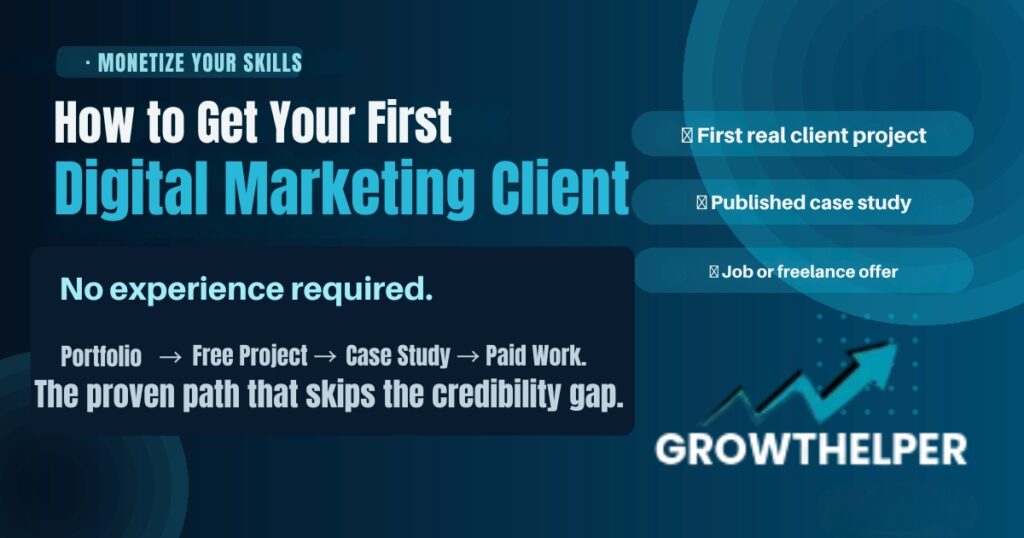
Network on LinkedIn with real, specific insight posts rather than generic content. In addition, reach out directly to marketing managers and agency owners with a specific portfolio link , because this approach consistently outperforms job board applications. The fastest path, therefore, is: practice portfolio → free project → published case study → targeted LinkedIn outreach → direct applications.
How do I write a digital marketing case study with no clients?
Start with your own practice site. Document the starting conditions, the actions you took week by week, and the results produced, with GA4 and Search Console screenshots. Because real data from a real site, even a small one, is always more convincing than a hypothetical or a classroom exercise.
Final Thought
The barrier to getting your first digital marketing client or job is not skill. It is not credentials. It is proof.
Every step in this guide, the practice portfolio, the free project, the case study, the LinkedIn posts is about generating that proof systematically. Consequently, when you do apply or reach out, you are not hoping someone takes a chance on you. You are showing them exactly what working with you looks like.
Build the proof first. The clients and the jobs follow.