You want to know how to start digital marketing from zero, but every guide you find either overwhelms you with jargon or tries to sell you a $497 course before explaining anything useful.
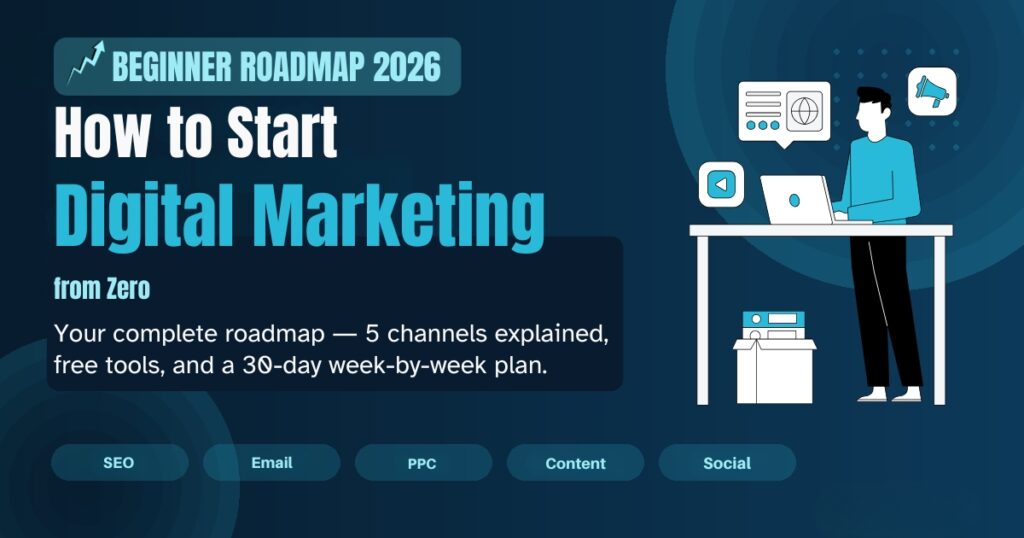
This guide is different. First, it explains what digital marketing actually is in plain language. Then, it shows you which channel matches your strengths. Finally, it gives you a clear, week-by-week action plan for your first 30 days, using only free tools.
No upsells. No fluff. Just the roadmap.
What Is Digital Marketing? (The Simple Version)
Digital marketing is how businesses get found, build trust, and win customers online. However, it is not one single skill. In fact, it is a family of connected channels, and understanding that from the start will save you months of wasted effort.
Here is what that family looks like:
SEO (Search Engine Optimization) helps your website appear in Google search results without paying for ads. Because organic search traffic compounds over time, SEO is one of the most valuable long-term investments in digital marketing.
Content marketing means publishing useful articles, guides, or videos that attract your target audience. Moreover, content marketing and SEO work together; SEO tells you what people are searching for, and content is how you answer those searches.
Email marketing lets you build a list of subscribers you own and nurture them directly. As a result, email consistently delivers the highest ROI of any digital channel, roughly $36 returned for every $1 spent, according to Litmus.
Social media marketing builds brand presence and community on platforms where your audience already spends time. However, what works on LinkedIn is completely different from what works on TikTok or Instagram.
Paid advertising (PPC) means running ads on Google or Meta for fast, measurable results. In contrast to SEO, paid ads deliver traffic immediately, but stop the moment your budget runs out.
Analytics is the practice of tracking what is working and making smarter decisions based on data. In other words, analytics is not a separate channel; it is the foundation that makes every other channel more effective.
Key takeaway: The biggest mistake beginners make is trying to learn all six channels at once. Therefore, the right approach is to understand the full landscape first, then go deep on one channel.
Two Different Starting Points, Which One Applies to You?
Before you take any action, you need to identify which path you are on. Because your goal determines your starting point.
Path A: You Are a Business Owner
You want more customers, more website traffic, and more revenue. As a result, you do not need to become a professional marketer. Instead, you need enough knowledge to make smart decisions and evaluate the people you hire.
Start with: SEO basics → Email list building → One paid channel
Path B: You Want a Digital Marketing Career or Freelance Income
You want a job at an agency, an in-house marketing role, or freelance clients. Therefore, you need demonstrable skills, a real portfolio, and certifications that signal competence to employers.
Start with: Choose one specialization → Build real projects → Document results → Get certified
The 5 Digital Marketing Channels Explained for Beginners
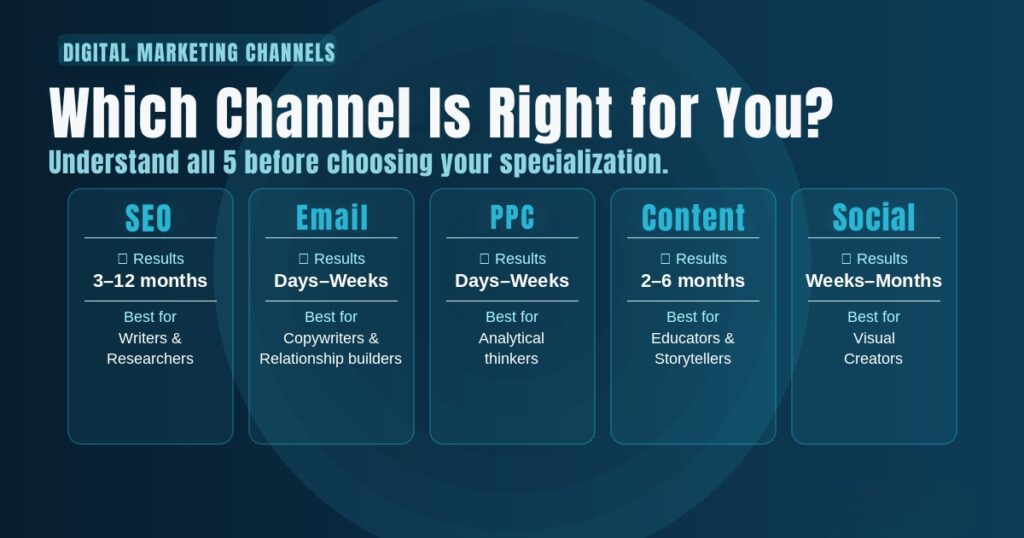
Understanding each channel before you choose your specialization is essential. Consequently, this section gives you a working knowledge of all five, so your choice in the next section is informed, not random.
1. SEO – The Long Game
SEO is the practice of making your website appear in Google search results when people search for relevant terms. For example, when someone types “best running shoes for flat feet” and clicks a non-ad result, SEO is why that site appears.
Why it matters: Google processes roughly 8.5 billion searches every day. Even a small share of that organic traffic is enormous, and moreover, it keeps arriving without ongoing cost once you earn it.
Reality check: SEO takes time. You will not see results in Week 1. However, the traffic it eventually produces is the most valuable in digital marketing because users are actively searching for exactly what you offer.
2. Content Marketing -Usefulness at Scale
Content marketing is publishing genuinely helpful articles, videos, or guides that attract your audience over time. In addition, it converts those readers into subscribers, leads, and eventually customers.
It is not about going viral. Instead, it is about consistently being the most helpful resource on a topic your audience cares about.
3. Email Marketing -The Asset You Own
Your email list is the one marketing asset that truly belongs to you. If Instagram disappears tomorrow, your followers go with it. If Google changes its algorithm, your traffic can drop overnight. Your email list, however, stays with you forever.
Because of this ownership advantage, building an email list early is one of the highest-leverage decisions a beginner can make, and one of the most commonly neglected.
4. Social Media Marketing -Reach and Community
Social media builds brand awareness and community at scale. Meanwhile, it is also the only channel where organic reach, posts that spread without paid promotion, can still generate significant results for free.
The key, however, is platform specificity. Pick one platform, learn its algorithm, and commit before expanding.
5. Paid Advertising – Speed and Data
Paid ads are the fastest way to generate traffic and test ideas. You can launch a campaign today and have data tomorrow. Consequently, paid ads are powerful for businesses that already know their customer and their offer.
For beginners, on the other hand, paid ads are better used as a learning tool than a primary revenue driver, because mistakes cost real money.
How to Choose Your Digital Marketing Specialization
Now that you understand the landscape, it is time to make the most important decision of your first month: choosing one specialization and going deep.
Ask yourself three questions:
1. What are you already good at?
- Writing well → SEO or content marketing
- Thinking analytically → Paid ads or analytics
- Creating visual content → Social media
- Building relationships → Email marketing
2. How quickly do you need to see results?
- Fast feedback → Paid ads or email marketing
- Long-term compounding value → SEO or content marketing
3. What kind of role or business are you building toward?
- Agency work → Paid ads and analytics skills are most valued
- In-house brand roles → Content and social media skills are most valued
- Freelance work → SEO audits and email setup are most accessible entry points
Therefore, use your answers to narrow the table below to one option:
| Specialization | Best for | Time to first results | Core skills |
| SEO | Writers, researchers, long-term thinkers | 3–12 months | Writing, keyword research, basic technical knowledge |
| Paid media (PPC) | Analytical, data-driven thinkers | Days to weeks | Numbers, testing, budget management |
| Email marketing | Relationship builders, copywriters | Days to weeks | Writing, segmentation, automation |
| Social media | Visual creators, community builders | Weeks to months | Content creation, platform knowledge |
| Content marketing | Educators, storytellers, strategists | Months | Writing, SEO basics, research |
Pick one. You can expand later, and you will. But for now, one channel is the only right answer.
Your First 30 Days: A Week-by-Week Action Plan
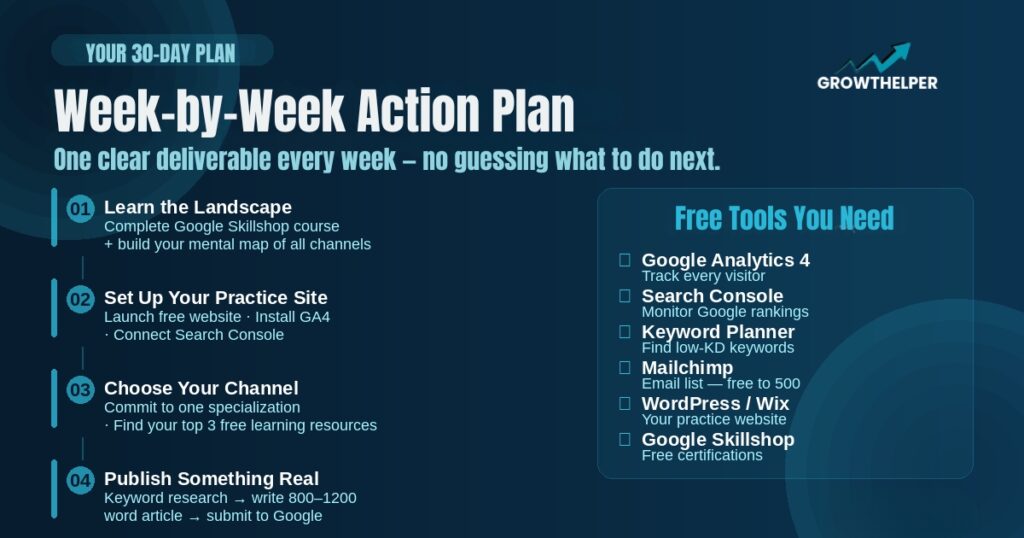
Here is exactly how to start digital marketing in your first month. Each week has a specific goal, specific actions, and a deliverable, so you always know what “done” looks like.
Week 1 → Understand the Landscape
Goal: Build a mental map of digital marketing before touching any free tool.
First, complete the free Google Digital Marketing Fundamentals course on Google Skillshop. It takes 4–6 hours and covers every major channel in plain language.
Then, read one current industry report, HubSpot’s State of Marketing is free and shows you which channels are delivering results right now in 2026.
Finally, watch 3–5 YouTube videos explaining the channel you are most curious about. You are not learning tactics yet. You are building a mental map.
Deliverable: You can explain what SEO, PPC, email marketing, and content marketing do, and how they connect.
Week 2 → Set Up Your Practice Ground
Goal: Get a real website live with real tracking. Because you cannot learn digital marketing without a place to practice.
Step 1: Create a free website on WordPress.com, Wix, or Google Sites. Pick any topic you know something about, a hobby, a skill, or a local interest. This is your sandbox.
Step 2: Install Google Analytics 4 (completely free). This tracks every visitor, every page view, and every action on your site. As a result, you will have real data to make real decisions.
Step 3: Connect Google Search Console (also free). This shows you how Google sees your site, which keywords bring visitors, and any technical issues hurting your visibility.
Step 4: Learn what these three metrics mean: sessions (total visits), bounce rate (visitors who leave immediately), and conversion rate (visitors who take your desired action). These are the three numbers you will check constantly.
Deliverable: A live website with GA4 and Search Console installed. You can read the basic dashboard.
Week 3 → Choose Your Specialization and Go Deep
Goal: Lock in your channel and spend the week studying only that one area.
Based on the framework above, commit to one specialization. Then, find the top 3 free learning resources for it:
- SEO: Ahrefs Blog, Moz Beginner’s Guide, Google Search Central documentation
- Paid ads: Google Skillshop (free Google Ads certification), Meta Blueprint (free Meta certification)
- Email marketing: Mailchimp Academy, HubSpot Email Marketing certification (free)
- Content marketing: HubSpot Content Marketing certification (free), Backlinko blog
- Social media: Platform-native creator academies, TikTok, YouTube, and LinkedIn all offer free training
Deliverable: One specialization chosen. A dedicated learning queue of 3 free resources.
Week 4 → Publish Something Real
Goal: Stop consuming and start creating. Something must go live this week.
First, use Google Keyword Planner (free with any Google account) to find one keyword with real search volume and manageable competition. Look for informational keywords starting with “how to,” “what is,” or “best way to.”
Then, write an 800–1,200-word article answering that keyword’s question as thoroughly and specifically as possible. Write for the person searching, not for the search engine.
Next, publish it with three essential on-page SEO elements:
- A title tag is the clickable headline that appears in Google search results
- A meta description is the preview text beneath the title in search results
- An H1 heading, the main heading visible on your page
Finally, submit the URL in Google Search Console under “URL Inspection” so Google crawls and indexes it faster.
Deliverable: One live, indexed article targeting a real keyword. GA4 is tracking it.
The Complete Free Toolkit for Your First 30 Days
You do not need to spend anything to learn how to start digital marketing. These tools cover every step:
| Tool | Purpose | Cost |
| Google Analytics 4 | Track all website traffic and user behavior | Free |
| Google Search Console | Monitor search performance and indexing | Free |
| Google Keyword Planner | Keyword research with real search volume data | Free |
| Google Skillshop | Google Ads and Analytics certifications | Free |
| HubSpot Academy | Content, email, and inbound certifications | Free |
| Mailchimp | Email list building and automation | Free up to 500 contacts |
| WordPress.com or Wix | Website creation and publishing | Free tier available |
| Canva | Graphics for social media and blog posts | Free tier available |
| Claude or ChatGPT | Content drafts, outlines, and research assistance | Free tier available |
4 Mistakes That Will Kill Your Progress in Month 1
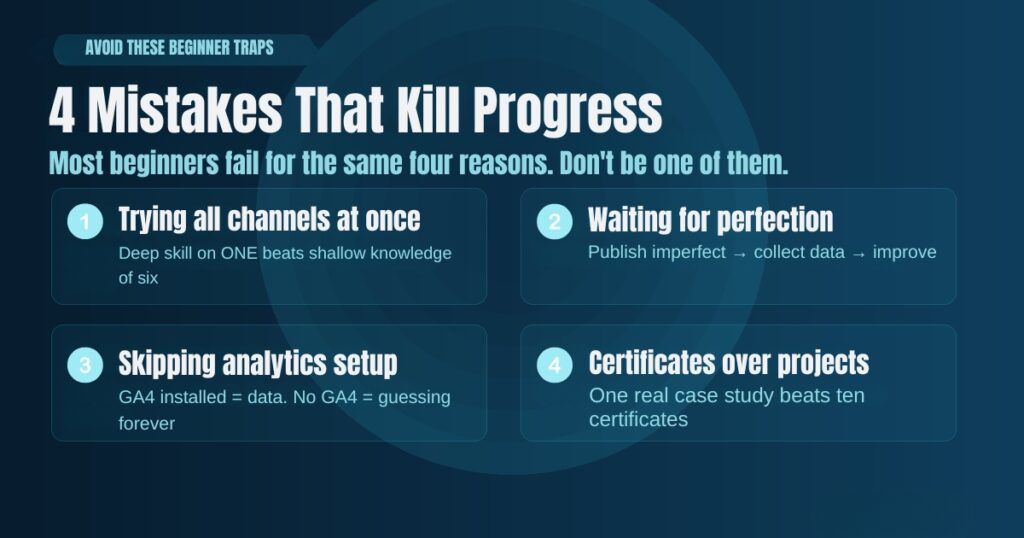
Knowing what to avoid is just as important as knowing what to do. Therefore, here are the four most common mistakes beginners make, and how to sidestep each one.
Mistake 1: Trying to learn all channels at once.
Jumping between SEO, paid ads, Instagram, and email in the same week is not learning; it is anxiety disguised as productivity. Consequently, you end up with shallow knowledge of six things and great skill in none. Pick one channel.
Mistake 2: Waiting until everything is perfect before publishing.
Your first article will not rank. Your first email will get a low open rate. However, that is completely expected. The data from imperfect experiments is precisely what teaches you to improve. Therefore, publish early and optimize based on what you learn.
Mistake 3: Skipping the analytics setup.
Marketing without tracking is guessing. If you skip GA4 in Week 2, you will have no idea what is working by Week 8. Moreover, analytics is the skill that separates professionals from hobbyists.
Mistake 4: Collecting certifications before building anything.
A certificate with no real project behind it means nothing to an employer or potential client. As a result, always build the project first, then earn the certification to validate the skill.
Frequently Asked Questions
How long does it take to learn digital marketing from scratch?
Most beginners develop job-ready skills in one specialization within 3–6 months of consistent, hands-on practice. Full-funnel proficiency across multiple channels typically takes 1–2 years. However, the 30-day plan above gets your foundation in place, and skill-building accelerates significantly in months 2 and 3.
Can I learn digital marketing for free?
Yes. SEO, content marketing, and email marketing require zero financial investment to learn. In fact, Google Analytics, Search Console, Keyword Planner, HubSpot Academy, Google Skillshop, and Mailchimp all have free tiers that are more than enough to build real, marketable skills.
What is the easiest digital marketing channel to start with?
Email marketing is often the quickest to learn and the fastest to show results. SEO, however, is the most valuable long-term investment for most beginners. If you are completely undecided, start with SEO , because the skills it builds (writing, keyword research, understanding user intent) transfer to every other channel.
Is digital marketing a good career in 2026?
Yes. Digital marketing roles are growing faster than the average for all careers. Moreover, the field offers remote work flexibility, multiple career tracks, in-house, agency, and freelance work, and is accessible without a specific degree. What matters most to employers is demonstrated results, which is exactly why building a portfolio matters more than any credential.
Do I need a degree to get a digital marketing job?
No. In fact, experience and a strong portfolio are more important than formal education in this field. A documented case study showing real results, even from a small practice project, is more convincing to most employers than a degree with no practical application.
What Comes Next
You now know what digital marketing is, which channel fits your strengths, and what to do in your first 30 days.
The next challenge, however, is a completely different one: turning these skills into income.
That means landing a real client project, building a case study that proves your results, getting certified on the right platforms, and positioning yourself where opportunities find you.
→ How to Get Your First Digital Marketing Client (Even with No Experience)
That article covers the exact steps to go from “I know digital marketing” to “I have a paying client or a confirmed job offer”, including a word-for-word outreach template and a case study formula that works even when your portfolio is brand new.