
Why Digital Marketing Is Important in 2026 (And Why You Can’t Ignore It)
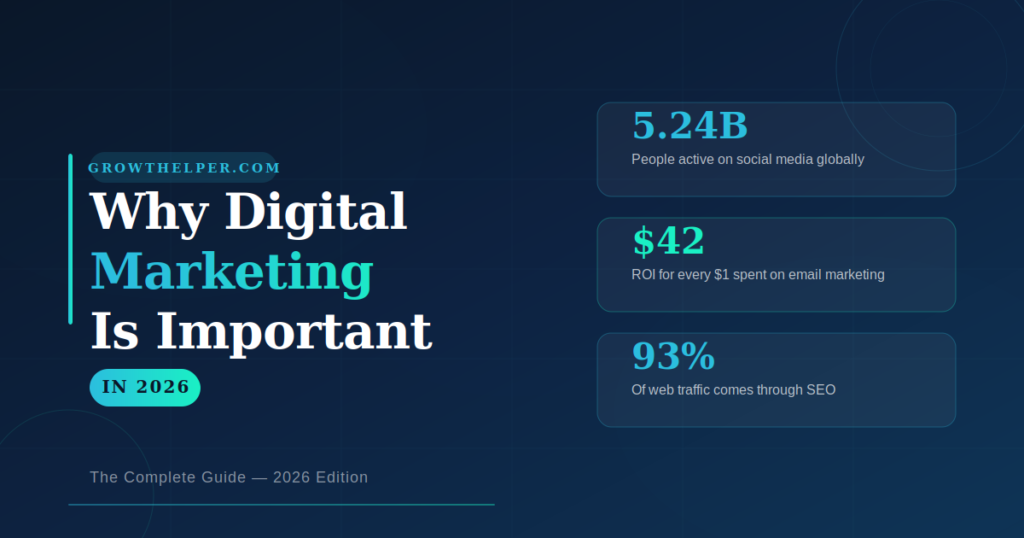
Think about the last time you found a new product without going online first. Maybe you Googled it. Maybe you saw it on Instagram. Maybe a YouTube review convinced you to buy it. Whatever the path, it happened online. That is exactly why digital marketing matters in 2026. Your customers are online. Their trust is shaped online. Their decisions are made online. If your business is not showing up in those moments, someone else is. This guide breaks down the real reasons digital marketing is no longer optional, with the numbers to back it up and a clear picture of how each piece works together. What Is Digital Marketing (And Why Does It Matter Now)? Digital marketing means promoting your business through online channels, search engines, social media, email, websites, and paid ads. It is not one thing. It is a system. SEO gets you found. Content builds trust. Email keeps customers coming back. Paid ads accelerate everything. Analytics tell you what is working. The reason it matters more in 2026 than ever before comes down to one simple fact: Over 5.24 billion people are now active on social media alone. That is 64% of the entire global population. [Source: Statista, 2024] Your audience is not watching TV and waiting for ads. They are scrolling, searching, and comparing options before they ever talk to a salesperson. Digital marketing is how you get in front of them, at the exact moment it matters. 10 Reasons Why Digital Marketing Is Important in 2026 1. The Internet Is Where Your Customers Already Are This is the foundational argument, and it is impossible to argue with. Over 97% of users check a business’s online presence before visiting a store or website. 93% of people read online reviews before making a purchase. More than 60% of global website traffic now comes from mobile devices. If a potential customer searches for what you sell and does not find you, they find your competitor. It is that simple. Traditional marketing puts your message in front of people who may or may not be interested. Digital marketing puts you in front of people who are actively looking for what you offer. That is a fundamental difference. 2. It Is Far More Affordable Than Traditional Advertising A 30-second TV spot costs tens of thousands of dollars. A full-page newspaper ad costs thousands, and disappears the next day. Neither tells you who actually saw it. Digital marketing changes that equation entirely. You can start SEO with zero budget, just time, and knowledge. Email marketing tools like Mailchimp offer free plans for up to 500 contacts. A well-targeted Facebook ad can reach thousands of people for $10 a day. Content you publish today can bring in traffic for years. About 58% of small businesses now use digital marketing to reach their customers, and it is not because they all have big budgets. It is because it works at every budget level. The playing field is more even than it has ever been. A smart small business with a good digital strategy can outperform a larger competitor that is still relying on traditional methods. 3. Every Result Is Measurable This is one of the biggest advantages digital marketing has over every other form of advertising. With a billboard, you guess how many people saw it. With a TV ad, you estimate. With digital marketing, you know. You can see: Exactly how many people visited your website Which pages they read and for how long Where they came from (Google, Instagram, email) What percentage converted into leads or buyers What does each conversion cost you Nearly 56% of marketers say it is much easier to improve conversion rates now than it was ten years ago. The reason is data. When you can measure everything, you can improve everything. Tools like Google Analytics 4 and Google Search Console are completely free and give you more insight into your audience than most traditional campaigns ever could. 4. You Can Reach Exactly the Right Person Traditional advertising is a broadcast. You send your message to everyone and hope the right people are watching. Digital marketing is a laser. You can target your ideal customer by: Demographics, age, gender, income, and education Location, city, region, or radius around your store Interests and behavior, what they have searched for, liked, or purchased Life stage: recently moved, just had a baby, planning a wedding Custom audiences, people who have already visited your website or are similar to your existing customers This precision means less wasted budget and higher returns. Businesses earn an average of $5 for every $1 spent on digital marketing, largely because you stop paying to reach people who were never going to buy anyway. 5. The ROI Is Simply Better Let the numbers speak: Channel Average ROI per $1 Spent Email marketing $36 – $42 SEO (organic search) ~$22 Social media ads ~$3 – $5 Google Ads (PPC) ~$2 Traditional TV/print Difficult to measure Sources: DemandSage 2026, WordStream 2026, HubSpot 2025 Email marketing generates $36 to $42 in ROI for every $1 spent, the highest among all forms of digital advertising. 49% of businesses say organic search brings them the best marketing ROI. And unlike paid ads, the traffic from SEO does not stop the moment you stop spending. The key insight: digital marketing channels compound over time. The blog post you publish today can bring in leads for the next three years. The email list you build now gets more valuable every month. 6. It Builds Real Trust and Brand Authority People do not buy from businesses they do not trust. Digital marketing is how you build that trust, before the customer ever makes a decision. This happens through: Consistent, useful content that answers their questions before they ask Social proof, reviews, testimonials, case studies, and user-generated content Engagement, responding to comments, answering DMs, being present SEO authority, ranking on the first page of Google, signals credibility by itself
Why Digital Marketing Is Important in 2026 (And Why You Can’t Ignore It) Read More »