Content Marketing

Attract and engage your audience with high-quality content marketing. We create SEO-optimized blogs, website content, and marketing copy that builds trust, improves rankings, and drives conversions.

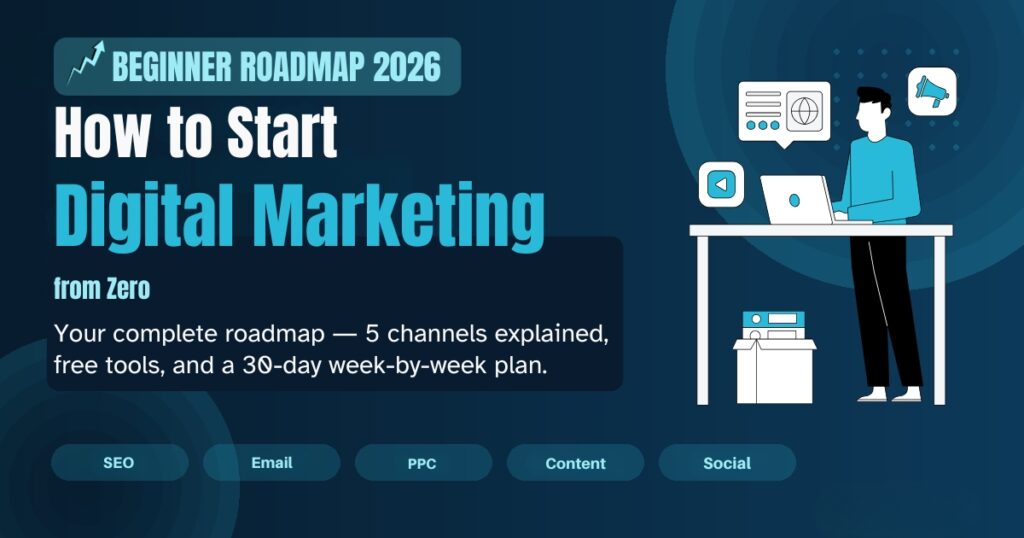
How to Start Digital Marketing from Zero (Free Roadmap 2026)

How to Start Digital Marketing from Zero (Free Roadmap 2026)

You want to know how to start digital marketing from zero,  but every guide you find either overwhelms you with jargon or tries to sell you a $497 course before explaining anything useful. This guide is different. First, it explains what digital marketing actually is in plain language. Then, it shows you which channel matches your strengths. Finally, it gives you a clear, week-by-week action plan for your first 30 days,  using only free tools. No upsells. No fluff. Just the roadmap. What Is Digital Marketing? (The Simple Version) Digital marketing is how businesses get found, build trust, and win customers online. However, it is not one single skill. In fact, it is a family of connected channels,  and understanding that from the start will save you months of wasted effort. Here is what that family looks like: SEO (Search Engine Optimization) helps your website appear in Google search results without paying for ads. Because organic search traffic compounds over time, SEO is one of the most valuable long-term investments in digital marketing. Content marketing means publishing useful articles, guides, or videos that attract your target audience. Moreover, content marketing and SEO work together; SEO tells you what people are searching for, and content is how you answer those searches. Email marketing lets you build a list of subscribers you own and nurture them directly. As a result, email consistently delivers the highest ROI of any digital channel,  roughly $36 returned for every $1 spent, according to Litmus. Social media marketing builds brand presence and community on platforms where your audience already spends time. However, what works on LinkedIn is completely different from what works on TikTok or Instagram. Paid advertising (PPC) means running ads on Google or Meta for fast, measurable results. In contrast to SEO, paid ads deliver traffic immediately,  but stop the moment your budget runs out. Analytics is the practice of tracking what is working and making smarter decisions based on data. In other words, analytics is not a separate channel; it is the foundation that makes every other channel more effective. Key takeaway: The biggest mistake beginners make is trying to learn all six channels at once. Therefore, the right approach is to understand the full landscape first,  then go deep on one channel. Two Different Starting Points,  Which One Applies to You? Before you take any action, you need to identify which path you are on. Because your goal determines your starting point. Path A: You Are a Business Owner You want more customers, more website traffic, and more revenue. As a result, you do not need to become a professional marketer. Instead, you need enough knowledge to make smart decisions and evaluate the people you hire. Start with: SEO basics → Email list building → One paid channel Path B: You Want a Digital Marketing Career or Freelance Income You want a job at an agency, an in-house marketing role, or freelance clients. Therefore, you need demonstrable skills, a real portfolio, and certifications that signal competence to employers. Start with: Choose one specialization → Build real projects → Document results → Get certified The 5 Digital Marketing Channels Explained for Beginners Understanding each channel before you choose your specialization is essential. Consequently, this section gives you a working knowledge of all five, so your choice in the next section is informed, not random. 1. SEO – The Long Game SEO is the practice of making your website appear in Google search results when people search for relevant terms. For example, when someone types “best running shoes for flat feet” and clicks a non-ad result, SEO is why that site appears. Why it matters: Google processes roughly 8.5 billion searches every day. Even a small share of that organic traffic is enormous,  and moreover, it keeps arriving without ongoing cost once you earn it. Reality check: SEO takes time. You will not see results in Week 1. However, the traffic it eventually produces is the most valuable in digital marketing because users are actively searching for exactly what you offer. 2. Content Marketing -Usefulness at Scale Content marketing is publishing genuinely helpful articles, videos, or guides that attract your audience over time. In addition, it converts those readers into subscribers, leads, and eventually customers. It is not about going viral. Instead, it is about consistently being the most helpful resource on a topic your audience cares about. 3. Email Marketing -The Asset You Own Your email list is the one marketing asset that truly belongs to you. If Instagram disappears tomorrow, your followers go with it. If Google changes its algorithm, your traffic can drop overnight. Your email list, however, stays with you forever. Because of this ownership advantage, building an email list early is one of the highest-leverage decisions a beginner can make,  and one of the most commonly neglected. 4. Social Media Marketing -Reach and Community Social media builds brand awareness and community at scale. Meanwhile, it is also the only channel where organic reach,  posts that spread without paid promotion,  can still generate significant results for free. The key, however, is platform specificity. Pick one platform, learn its algorithm, and commit before expanding. 5. Paid Advertising – Speed and Data Paid ads are the fastest way to generate traffic and test ideas. You can launch a campaign today and have data tomorrow. Consequently, paid ads are powerful for businesses that already know their customer and their offer. For beginners, on the other hand, paid ads are better used as a learning tool than a primary revenue driver,  because mistakes cost real money. How to Choose Your Digital Marketing Specialization Now that you understand the landscape, it is time to make the most important decision of your first month: choosing one specialization and going deep. Ask yourself three questions: 1. What are you already good at? 2. How quickly do you need to see results? 3. What kind of role or business are you building toward? Therefore, use your answers to

How to Start Digital Marketing from Zero (Free Roadmap 2026) Read More »

What Is Digital Marketing (And Why Does It Matter Now)?

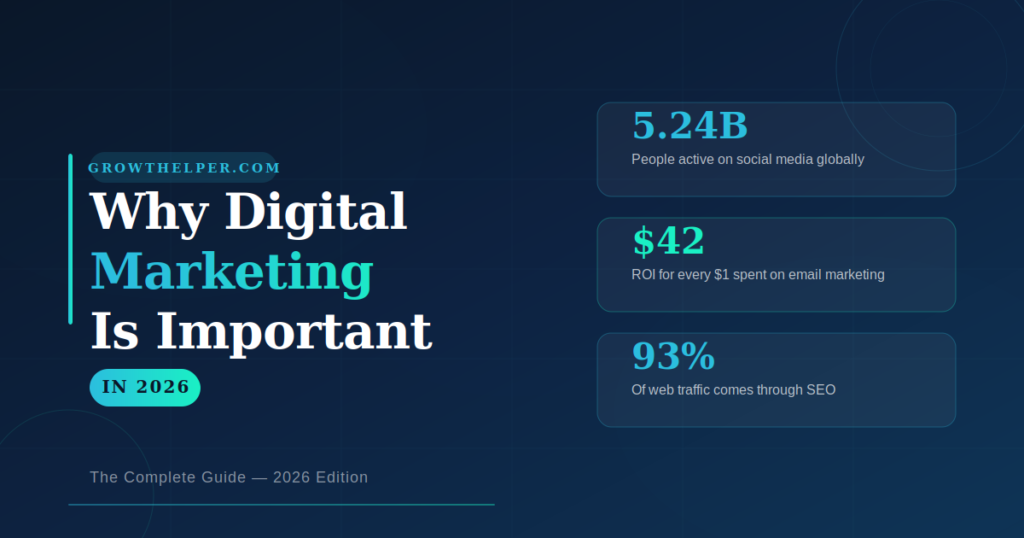
Why Digital Marketing Is Important in 2026 (And Why You Can’t Ignore It)

Think about the last time you found a new product without going online first. Maybe you Googled it. Maybe you saw it on Instagram. Maybe a YouTube review convinced you to buy it. Whatever the path,  it happened online. That is exactly why digital marketing matters in 2026. Your customers are online. Their trust is shaped online. Their decisions are made online. If your business is not showing up in those moments, someone else is. This guide breaks down the real reasons digital marketing is no longer optional,  with the numbers to back it up and a clear picture of how each piece works together. What Is Digital Marketing (And Why Does It Matter Now)? Digital marketing means promoting your business through online channels,  search engines, social media, email, websites, and paid ads. It is not one thing. It is a system. SEO gets you found. Content builds trust. Email keeps customers coming back. Paid ads accelerate everything. Analytics tell you what is working. The reason it matters more in 2026 than ever before comes down to one simple fact: Over 5.24 billion people are now active on social media alone. That is 64% of the entire global population. [Source: Statista, 2024] Your audience is not watching TV and waiting for ads. They are scrolling, searching, and comparing options before they ever talk to a salesperson. Digital marketing is how you get in front of them,  at the exact moment it matters. 10 Reasons Why Digital Marketing Is Important in 2026 1. The Internet Is Where Your Customers Already Are This is the foundational argument, and it is impossible to argue with.   Over 97% of users check a business’s online presence before visiting a store or website. 93% of people read online reviews before making a purchase. More than 60% of global website traffic now comes from mobile devices. If a potential customer searches for what you sell and does not find you,  they find your competitor. It is that simple. Traditional marketing puts your message in front of people who may or may not be interested. Digital marketing puts you in front of people who are actively looking for what you offer. That is a fundamental difference. 2. It Is Far More Affordable Than Traditional Advertising A 30-second TV spot costs tens of thousands of dollars. A full-page newspaper ad costs thousands,  and disappears the next day. Neither tells you who actually saw it. Digital marketing changes that equation entirely.   You can start SEO with zero budget,  just time, and knowledge. Email marketing tools like Mailchimp offer free plans for up to 500 contacts. A well-targeted Facebook ad can reach thousands of people for $10 a day. Content you publish today can bring in traffic for years. About 58% of small businesses now use digital marketing to reach their customers,  and it is not because they all have big budgets. It is because it works at every budget level. The playing field is more even than it has ever been. A smart small business with a good digital strategy can outperform a larger competitor that is still relying on traditional methods. 3. Every Result Is Measurable This is one of the biggest advantages digital marketing has over every other form of advertising. With a billboard, you guess how many people saw it. With a TV ad, you estimate. With digital marketing, you know. You can see:   Exactly how many people visited your website Which pages they read and for how long Where they came from (Google, Instagram, email) What percentage converted into leads or buyers What does each conversion cost you Nearly 56% of marketers say it is much easier to improve conversion rates now than it was ten years ago. The reason is data. When you can measure everything, you can improve everything. Tools like Google Analytics 4 and Google Search Console are completely free and give you more insight into your audience than most traditional campaigns ever could. 4. You Can Reach Exactly the Right Person Traditional advertising is a broadcast. You send your message to everyone and hope the right people are watching. Digital marketing is a laser. You can target your ideal customer by:   Demographics,  age, gender, income, and education Location,  city, region, or radius around your store Interests and behavior,  what they have searched for, liked, or purchased Life stage: recently moved, just had a baby, planning a wedding Custom audiences,  people who have already visited your website or are similar to your existing customers This precision means less wasted budget and higher returns. Businesses earn an average of $5 for every $1 spent on digital marketing,  largely because you stop paying to reach people who were never going to buy anyway. 5. The ROI Is Simply Better Let the numbers speak: Channel Average ROI per $1 Spent Email marketing $36 – $42 SEO (organic search) ~$22 Social media ads ~$3 – $5 Google Ads (PPC) ~$2 Traditional TV/print Difficult to measure Sources: DemandSage 2026, WordStream 2026, HubSpot 2025 Email marketing generates $36 to $42 in ROI for every $1 spent,  the highest among all forms of digital advertising. 49% of businesses say organic search brings them the best marketing ROI. And unlike paid ads, the traffic from SEO does not stop the moment you stop spending. The key insight: digital marketing channels compound over time. The blog post you publish today can bring in leads for the next three years. The email list you build now gets more valuable every month. 6. It Builds Real Trust and Brand Authority People do not buy from businesses they do not trust. Digital marketing is how you build that trust,  before the customer ever makes a decision. This happens through:   Consistent, useful content that answers their questions before they ask Social proof,  reviews, testimonials, case studies, and user-generated content Engagement,  responding to comments, answering DMs, being present SEO authority,  ranking on the first page of Google, signals credibility by itself

Why Digital Marketing Is Important in 2026 (And Why You Can’t Ignore It) Read More »