Think about the last time you found a new product without going online first.
Maybe you Googled it. Maybe you saw it on Instagram. Maybe a YouTube review convinced you to buy it. Whatever the path, it happened online.
That is exactly why digital marketing matters in 2026. Your customers are online. Their trust is shaped online. Their decisions are made online. If your business is not showing up in those moments, someone else is.
This guide breaks down the real reasons digital marketing is no longer optional, with the numbers to back it up and a clear picture of how each piece works together.
What Is Digital Marketing (And Why Does It Matter Now)?
Digital marketing means promoting your business through online channels, search engines, social media, email, websites, and paid ads.
It is not one thing. It is a system. SEO gets you found. Content builds trust. Email keeps customers coming back. Paid ads accelerate everything. Analytics tell you what is working.
The reason it matters more in 2026 than ever before comes down to one simple fact:
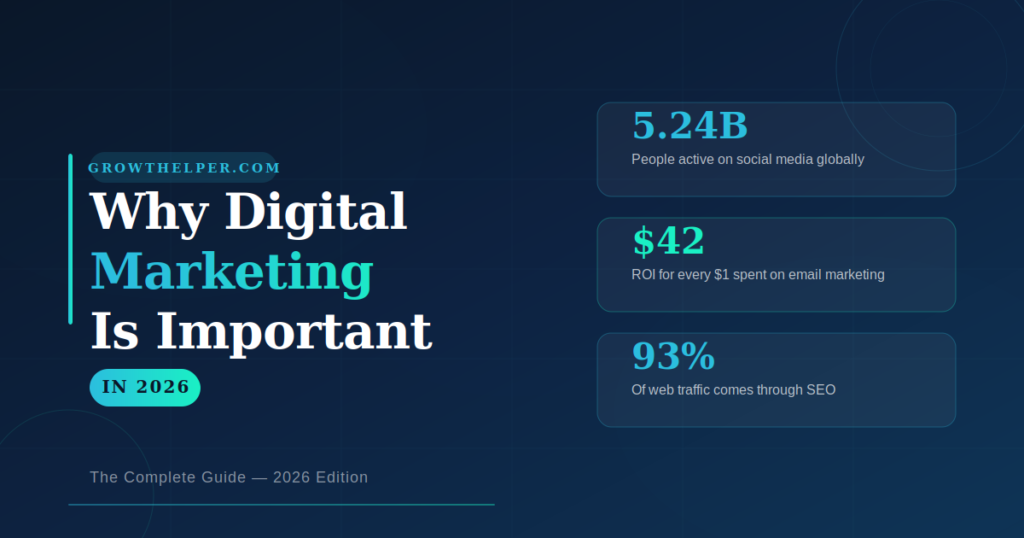
Over 5.24 billion people are now active on social media alone. That is 64% of the entire global population. [Source: Statista, 2024]
Your audience is not watching TV and waiting for ads. They are scrolling, searching, and comparing options before they ever talk to a salesperson. Digital marketing is how you get in front of them, at the exact moment it matters.
10 Reasons Why Digital Marketing Is Important in 2026
1. The Internet Is Where Your Customers Already Are
This is the foundational argument, and it is impossible to argue with.
-
- Over 97% of users check a business’s online presence before visiting a store or website.
-
- 93% of people read online reviews before making a purchase.
-
- More than 60% of global website traffic now comes from mobile devices.
If a potential customer searches for what you sell and does not find you, they find your competitor. It is that simple.
Traditional marketing puts your message in front of people who may or may not be interested. Digital marketing puts you in front of people who are actively looking for what you offer. That is a fundamental difference.
2. It Is Far More Affordable Than Traditional Advertising
A 30-second TV spot costs tens of thousands of dollars. A full-page newspaper ad costs thousands, and disappears the next day. Neither tells you who actually saw it.
Digital marketing changes that equation entirely.
-
- You can start SEO with zero budget, just time, and knowledge.
-
- Email marketing tools like Mailchimp offer free plans for up to 500 contacts.
-
- A well-targeted Facebook ad can reach thousands of people for $10 a day.
-
- Content you publish today can bring in traffic for years.
About 58% of small businesses now use digital marketing to reach their customers, and it is not because they all have big budgets. It is because it works at every budget level.
The playing field is more even than it has ever been. A smart small business with a good digital strategy can outperform a larger competitor that is still relying on traditional methods.
3. Every Result Is Measurable
This is one of the biggest advantages digital marketing has over every other form of advertising.
With a billboard, you guess how many people saw it. With a TV ad, you estimate. With digital marketing, you know.
You can see:
-
- Exactly how many people visited your website
-
- Which pages they read and for how long
-
- Where they came from (Google, Instagram, email)
-
- What percentage converted into leads or buyers
-
- What does each conversion cost you
Nearly 56% of marketers say it is much easier to improve conversion rates now than it was ten years ago. The reason is data. When you can measure everything, you can improve everything.
Tools like Google Analytics 4 and Google Search Console are completely free and give you more insight into your audience than most traditional campaigns ever could.
4. You Can Reach Exactly the Right Person
Traditional advertising is a broadcast. You send your message to everyone and hope the right people are watching.
Digital marketing is a laser.
You can target your ideal customer by:
-
- Demographics, age, gender, income, and education
-
- Location, city, region, or radius around your store
-
- Interests and behavior, what they have searched for, liked, or purchased
-
- Life stage: recently moved, just had a baby, planning a wedding
-
- Custom audiences, people who have already visited your website or are similar to your existing customers
This precision means less wasted budget and higher returns. Businesses earn an average of $5 for every $1 spent on digital marketing, largely because you stop paying to reach people who were never going to buy anyway.
5. The ROI Is Simply Better
Let the numbers speak:
| Channel | Average ROI per $1 Spent |
| Email marketing | $36 – $42 |
| SEO (organic search) | ~$22 |
| Social media ads | ~$3 – $5 |
| Google Ads (PPC) | ~$2 |
| Traditional TV/print | Difficult to measure |
Sources: DemandSage 2026, WordStream 2026, HubSpot 2025
Email marketing generates $36 to $42 in ROI for every $1 spent, the highest among all forms of digital advertising.
49% of businesses say organic search brings them the best marketing ROI. And unlike paid ads, the traffic from SEO does not stop the moment you stop spending.
The key insight: digital marketing channels compound over time. The blog post you publish today can bring in leads for the next three years. The email list you build now gets more valuable every month.
6. It Builds Real Trust and Brand Authority
People do not buy from businesses they do not trust. Digital marketing is how you build that trust, before the customer ever makes a decision.
This happens through:
-
- Consistent, useful content that answers their questions before they ask
-
- Social proof, reviews, testimonials, case studies, and user-generated content
-
- Engagement, responding to comments, answering DMs, being present
-
- SEO authority, ranking on the first page of Google, signals credibility by itself
Customers spend 50% more with businesses that regularly respond to reviews. That is not a small number. Just showing up and engaging, even with a simple thank-you, directly impacts revenue.
Less than 1% of searchers go past the first page of search results. If you are on page one, you are trusted by default. If you are on page three, you effectively do not exist.
7. It Supports Growth at Any Stage
One of the most underappreciated things about digital marketing is how well it scales.
You do not need to launch with a massive campaign. You can:
-
- Start with a free blog and Google Search Console
-
- Add email capture once you have content people want to read
-
- Run small paid ad tests once you understand your audience
-
- Scale what works, cut what does not
63% of businesses have already increased their digital marketing budgets in recent years. The businesses that grow fastest are not necessarily the ones with the biggest budgets; they are the ones that started early and built consistently.
A startup can rank on Google alongside a Fortune 500 company if the content is better and more relevant. That level of access does not exist in traditional media.
8. AI Has Made It Smarter and More Efficient
In 2026, artificial intelligence is not a future concept in digital marketing; it is already embedded in every layer of it.
-
- 75% of marketers now use AI daily. 76% use it specifically for content creation, reporting a 32% productivity gain.
-
- 85% of marketing tasks are now automatable through AI tools.
-
- Over 91% of Fortune 1000 companies are already investing in AI-driven campaigns.
What does this mean practically?
AI tools now help marketers write faster, target better, personalize at scale, and analyze data that would have taken a full team weeks to process. Email sequences can be personalized to individual behavior. Ad creative can be tested in hundreds of variations simultaneously. Chatbots can qualify leads 24 hours a day.
The important caveat: AI amplifies your strategy. It does not replace it. Businesses with poor strategic thinking will produce poor output faster. The ones who win combine AI efficiency with human judgment.
9. Your Competitors Are Already Doing It
This is not a scare tactic. It is a market reality.
The compound annual growth rate of digital marketing from 2020 to 2026 is projected at 9%. 63% of businesses have already increased their digital marketing budgets.
SEO alone accounts for 93% of all web traffic. If your competitors are ranking for the keywords your customers search, and you are not, that traffic is going to them every single day.
Digital marketing is considered the fastest-growing in-demand job skill for 2025. The businesses investing in it now are building compounding advantages, more content, more backlinks, more email subscribers, more data, that get harder to close over time.
Waiting is not a neutral decision. It is a decision to fall further behind.
10. It Future-Proofs Your Business
The businesses that thrive through economic uncertainty, platform changes, and shifting consumer behavior are the ones with diversified digital foundations.
-
- An email list you own is safe from algorithm changes
-
- SEO authority built over the years does not disappear overnight
-
- A loyal online community drives referrals without ad spend
The digital marketing industry was worth $531 billion in 2022 and is projected to hit $807 billion by 2026. The investment is growing because the returns are growing.
Building your digital presence now is not just a marketing strategy. It is business infrastructure.
Digital Marketing vs. Traditional Marketing: A Clear Comparison
| Factor | Digital Marketing | Traditional Marketing |
| Cost | Low to medium, scalable | High upfront investment |
| Measurability | Every action tracked | Estimated, not precise |
| Targeting | Highly specific by behavior, interest, and location | Broad audience, high waste |
| Speed | Campaigns live in hours | Weeks to plan and execute |
| Reach | Global with no extra cost | Geographic limitations |
| Engagement | Two-way, customers interact | One-way broadcast |
| ROI tracking | Real-time | Delayed or unavailable |
| Adjustability | Edit and optimize anytime | Locked once published |
The conclusion is not that traditional marketing is dead; TV and print still have roles in certain strategies. But for most businesses, digital marketing delivers better returns with less risk and more control.
The Channels That Matter Most in 2026
Not all digital marketing channels deliver equal results for every business. Here is a clear breakdown:
SEO (Search Engine Optimization) Best for long-term organic traffic that compounds over time. SEO remains the primary acquisition channel with 93% of web traffic. Takes 3–12 months to show results, but pays dividends for years.
Email Marketing Best for nurturing leads and retaining customers. The highest ROI channel in digital marketing. Build your list from day one, you own it regardless of platform changes.
Social Media Marketing Best for brand awareness, community building, and reaching new audiences. TikTok’s global ad revenue is projected to reach $43.96 billion in 2026. Short-form video delivers the highest engagement across platforms.
Pay-Per-Click Advertising (PPC) Best for fast, intent-based traffic. Google Ads targets people actively searching for your product. Results are immediate but stop when spending stops. Google is projected to generate around $357 billion in ad revenue in 2026, roughly 44% of global ad earnings.
Content Marketing is best for authority building, SEO, and educating your audience before they buy. The global content marketing market is projected to hit $107 billion by 2026.
Common Misconceptions About Digital Marketing
“I need a huge budget to start.” Wrong. SEO and email marketing cost nothing but time. Many of the most effective channels, organic search, content, and social media, are free to use. Budget accelerates results; it does not create them on its own.
“It will show results immediately.” Paid ads produce fast results. SEO and content take months. Email marketing compounds over time. Anyone promising overnight organic results from digital marketing is misleading you.
“It only works for big businesses.” The opposite is often true. Digital marketing gives small businesses access to the same channels and audiences as enterprises. A well-written blog post from a local business can outrank a global brand for local search terms.
“Social media followers are the real measure of success.” Vanity metrics , likes, followers, and impressions , do not pay bills. Conversions, leads, and revenue do. A 300-person email list that trusts you is worth more than 30,000 social followers who do not engage.
Frequently Asked Questions
Why is digital marketing important for small businesses?
Small businesses benefit most from digital marketing because it levels the playing field. A local business with strong SEO and a good email list can compete directly with much larger competitors, without the budget required for traditional advertising.
Is digital marketing better than traditional marketing?
For most businesses in 2026, yes. Digital marketing is more measurable, more affordable, more targeted, and more adjustable than traditional methods. However, they are not mutually exclusive; some brands use both effectively.
How long does digital marketing take to show results?
It depends on the channel. Paid advertising shows results within days. SEO typically takes 3–12 months for meaningful organic traffic. Email marketing compounds over time as your list grows. Content marketing builds authority over 6–18 months.
What is the most important digital marketing channel in 2026?
There is no single answer; it depends on your audience, business model, and timeline. That said, SEO and email marketing consistently deliver the highest long-term ROI for most businesses. Start with those two before expanding into paid channels.
Do I need a big team to do digital marketing?
No. Many businesses run effective digital marketing with one person and a handful of free tools. Google Analytics, Search Console, Mailchimp, and Canva are all free and powerful enough to drive real results without a full team.
Final Thoughts
Digital marketing is important in 2026 because your customers live online, and their decisions are shaped by what they find there.
It is the most measurable, most affordable, most targeted form of marketing ever developed. It works for startups and enterprises, for product businesses and service providers, for solo operators and large teams.
The businesses that invest in it consistently, building content, growing email lists, optimizing for search, and analyzing their results, create compounding advantages that are very difficult for latecomers to catch up to.
The ones that wait are not standing still. They are falling behind.
Start with one channel. Learn it well. Measure your results. Build from there.
Ready to take the first step? Read our complete guide on [How to Start Digital Marketing] for a step-by-step 90-day roadmap.